





























A Delhi Teen's Physics Breakthrough Could Help Lower Petrol Prices to ₹74!


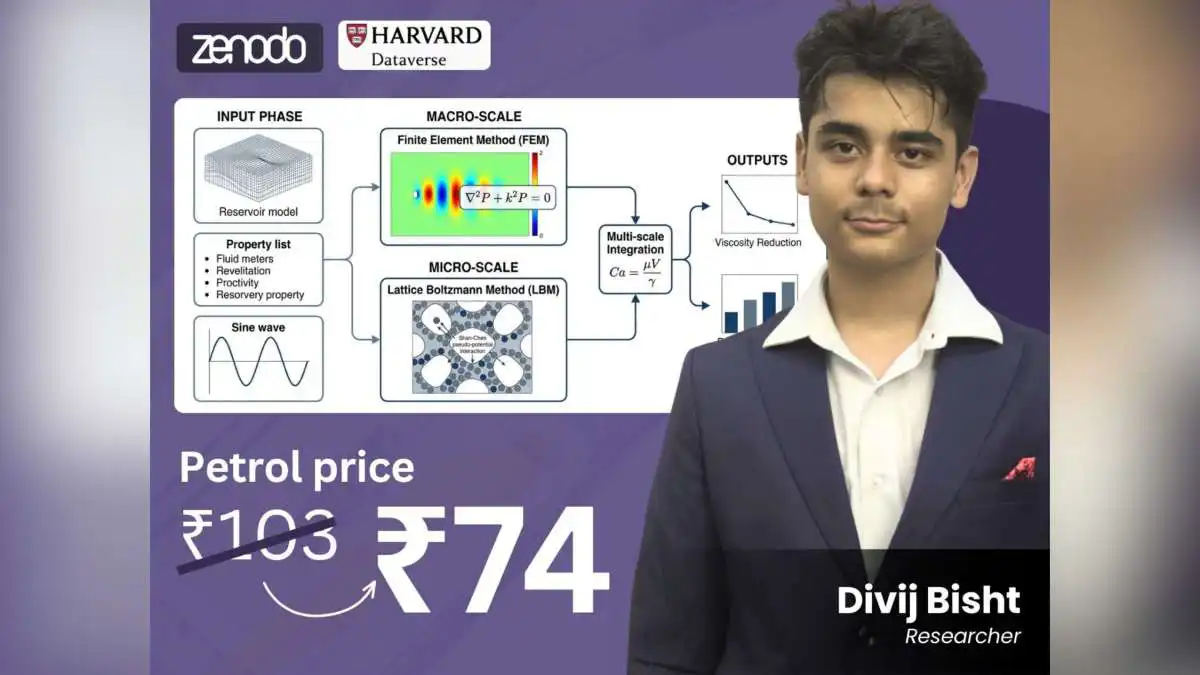

Pulling up to the petrol pump could soon become a lot lighter on the wallet thanks to a Delhi high school student and physics enthusiast named Divij Bisht. Operating out of his home in Vasundhara Enclave, Delhi, Bisht has proposed an innovative acoustic extraction process that could potentially flood the market with easily accessible oil. Detailed in his comprehensive research paper, titled "Acoustic Resonance in Subsurface Fluid Dynamics," the young researcher outlines a method that could crash the production cost of fuel, aiming to help bring retail prices down from a heavy ₹103 to a much more manageable ₹74.
While many high schoolers are focusing purely on their board exams, Bisht has been diving deep into the complex world of subsurface fluid dynamics to address a glaring inefficiency in how global energy companies extract fuel. According to his research, traditional pressure-driven oil drilling is incredibly inefficient, frequently leaving up to 60% of the target fluids permanently trapped inside the rock matrix. This massive loss happens because of high fluid viscosity and strong capillary forces, which essentially mean the oil is too thick and sticky, causing it to remain trapped in microscopic pores deep underground.
Instead of relying on harsh chemicals or extreme pressure to force the oil out, Bisht explored a much more elegant solution: shaking it loose with sound. The core of his research revolves around acoustic resonance, bridging macro-scale acoustics with micro-scale fluid models to develop a fascinating theoretical framework. Just like a singer hitting a specific note to shatter a glass, Bisht's computer models use the Finite Element Method to find the exact natural resonant frequency of the trapped oil droplets. By sending these specific acoustic waves deep underground, the sound vibrations disrupt the surface tension that holds the oil in place, causing the trapped droplets to vibrate, combine, and become significantly thinner. His models show that using high-frequency ultrasonic waves can reduce the thickness of heavy oil by up to 30%, while mid-frequency sonic waves can boost the effective flow of oil by a massive 62.5%.
This sound-wave technology translates to a potential price drop at the pump through simple supply and extraction economics. By dramatically increasing how much oil can be pulled from existing wells, Bisht's acoustic stimulation could severely reduce the need for expensive, environmentally taxing new drilling operations. His models demonstrate that this technology can reduce the amount of wasted, trapped oil by up to 40%. If this extraction efficiency is scaled to the real world, the global supply of crude oil would increase exponentially, dropping production costs and making the move toward ₹74 petrol a very real possibility. While Bisht is candid in his paper about the real-world engineering hurdles that remain—such as sound waves losing energy quickly deep underground and the need for equipment that can survive temperatures of 150°C and crushing pressures of 5000 psi—his acoustic breakthrough lays a mathematically sound pathway that might just change the way we fuel the world.
What's Your Reaction?
 Like
0
Like
0
 Dislike
0
Dislike
0
 Love
0
Love
0
 Funny
0
Funny
0
 Angry
0
Angry
0
 Sad
0
Sad
0
 Wow
0
Wow
0